 edeale
Two Discount Categories, Two Different Risk Profiles
“Open-box” and “refurbished” both promise a discount off new, and both get used loosely by sellers — but they describe genuinely different histories, and that difference affects what you should check before buying.
This guide breaks down what each term is actually supposed to mean, how the two compare on warranty, testing, and typical savings, and the specific questions worth asking before choosing either one over buying new.
- What “open-box” and “refurbished” each actually mean
- How warranty coverage typically differs between the two
- The condition-grading language sellers use, and what it hides
- A short checklist to run before buying either category
“Refurbished” and “open-box” both cover a wide range of actual conditions depending on the seller. Asking specifically what was tested, repaired, or replaced tells you far more than the label alone.
What Each Term Is Actually Supposed to Mean
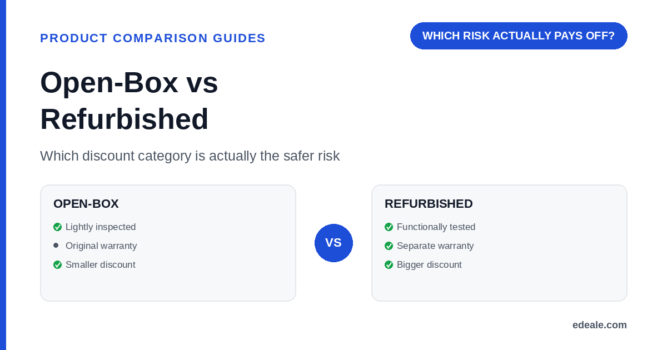
Open-Box vs Refurbished, Defined
- Open-box
An item that was purchased, then returned unused or lightly used — typically inspected and repackaged, but not necessarily tested component-by-component.
- Refurbished
A previously used, returned, or repaired item that’s gone through a formal inspection and repair process before resale — often by the manufacturer or an authorized third party.
- Manufacturer refurbished
Refurbishment done directly by the brand or an authorized partner, typically the most consistent quality tier and often the closest warranty terms to new.
- Third-party refurbished
Refurbishment done by a reseller not directly authorized by the manufacturer — quality and testing rigor vary far more here.
- Grade A / B / C condition
A seller’s own cosmetic and functional grading scale — not standardized across sellers, so “Grade A” from one seller isn’t guaranteed to match another’s.
Open-Box vs Refurbished — Side by Side
A Checklist Before Buying Either One
What to Check Before Buying Open-Box or Refurbished
-
Ask who performed the refurbishment
Manufacturer or authorized-partner refurbishment is generally more consistent than an unaffiliated third-party seller’s own process.
-
Get the exact warranty terms in writing
Confirm the length and what’s covered — some refurbished warranties exclude specific components or offer a shorter window than new.
-
Ask what specifically was tested or replaced
A seller who can name specific tests or replaced parts is more credible than one who only offers a condition label.
-
Check the return window separately from the warranty
A short return window on a used item leaves little time to discover a problem — confirm the number of days explicitly.
-
Compare the price against a genuinely new unit, not just the original MSRP
The relevant comparison is against what a new unit actually costs today, which may already be discounted.
None of this rules out buying open-box or refurbished — it just means confirming the details instead of trusting the label alone.
A seller who can’t or won’t explain what a “Grade A” or “Excellent” condition label specifically means for that item — what was checked, what (if anything) shows wear — is giving you less information than the label implies.
Where Comparisons Go Wrong
Confirming the exact model number matters just as much here as with any other comparison — an open-box or refurbished listing should still specify the precise model, and a listing that’s vague about it deserves extra scrutiny. It’s also worth applying the same review-reading process specifically to reviews of the refurbished or open-box program itself, not just the product in general, since experiences can differ from buying new.
The same condition grade from two different sellers can mean very different things in practice. See our guide on choosing a trustworthy online retailer for how to evaluate the seller behind an open-box or refurbished listing, not just the listing itself.
Open-Box vs Refurbished FAQ
Is refurbished or open-box the safer choice?
Neither is automatically safer — a manufacturer-refurbished item with a solid warranty can be a safer bet than an open-box item from a seller who only did a visual check, and vice versa.
Does open-box always mean the item was never used?
No. Open-box covers a range of real histories, from genuinely unused returns to lightly used items — the seller’s specific description and return reason matter more than the label.
How much can I typically expect to save on refurbished items?
Savings vary widely by product, seller, and condition grade, so check the current price against what a new unit costs today rather than relying on a general expectation.
Does manufacturer refurbished cost more than third-party refurbished?
Often somewhat more, reflecting the more consistent testing and warranty terms — whether that premium is worth it depends on how much you value warranty certainty.
What's the most important question to ask a refurbished seller?
What specifically was tested or replaced, and what the exact warranty terms are — a specific answer to both is far more useful than a condition grade alone.
Should I trust a seller's own condition grading scale?
Treat it as a starting point, not a guarantee, since grading scales aren’t standardized across sellers — the same grade can mean different things at two different stores.
Is the return window the same as the warranty period?
No — they’re separate. Confirm both explicitly, since a short return window gives you less time to catch a problem even under a longer warranty.
Can I compare an open-box listing to a new listing using the same checklist?
Yes — confirm the model number, check the warranty and return terms, and read reviews specific to that condition category before deciding either way.
Related Reading
- How to Compare Products Before You Buy With Confidence
- Latest Model vs Previous Model: When the Upgrade Pays
- How to Choose a Trustworthy Online Retailer
- How We Verify Listings and Claims
Check the warranty before you save
Search for the exact listing you’re considering, or browse today’s verified deals to compare new, open-box, and refurbished pricing.
The label matters less than what's behind it
Open-box and refurbished can both be genuinely good value, and both can also hide real risk depending entirely on the seller behind the listing. Ask who did the work, what was tested, and what the warranty actually covers before the discount factors into your decision.