 edeale
Compatible Doesn't Always Mean Equivalent
Third-party accessories can be a genuine bargain, built to the same standard as the original at a fraction of the price. They can also cut corners in ways that are invisible until something fails — sometimes taking the original device down with it.
This guide covers where original accessories are worth the premium, where compatible ones are a safe and sensible saving, and the specific checks that separate a well-made compatible accessory from a risky one.
- Where a compatible accessory genuinely matches the original
- The specific categories where cutting corners causes real damage
- What certification and compliance marks actually tell you
- A checklist to run before buying any compatible accessory
Some accessory categories — like cables and cases — have low failure consequences even from a poorly made compatible version. Others — like chargers and batteries — can cause real damage if built to a lower standard. The category matters more than any single brand’s reputation.
Where Compatible Accessories Are a Safe Bet
Lower-Risk Categories for Compatible Accessories
Where Original Is Usually Worth the Premium
Higher-Risk Categories Worth Extra Scrutiny
For anything involving electricity — chargers, batteries, power cables — check for a recognized safety certification mark. A listing with no certification mentioned at all, especially at an unusually low price, carries more real risk than the savings are worth.
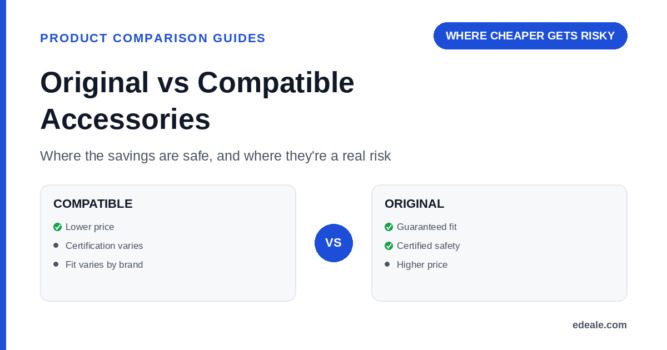
Original vs Compatible — At a Glance
A Checklist Before Buying a Compatible Accessory
What to Check Before Buying a Compatible Accessory
-
Identify whether the category involves electricity
Cases, mounts, and data-only cables carry low risk. Chargers, batteries, and power cables need more scrutiny.
-
Check for a recognized safety certification mark
For anything electrical, confirm the listing states a real certification, not just the word “certified” with no specific standard named.
-
Read reviews specifically about long-term reliability
A compatible accessory’s real failure rate usually shows up in reviews after weeks or months of use, not in the first impression.
-
Confirm it won't affect your device's warranty
Check the original manufacturer’s actual warranty terms — many don’t void coverage for third-party accessories unless the accessory directly caused damage.
-
Compare the price gap against the actual risk
A small saving on a high-risk category (like a battery) is rarely worth it; a large saving on a low-risk category (like a case) usually is.
This checklist takes longer for electrical accessories and barely any time at all for purely physical ones.
Where Comparisons Go Wrong
The same review-reading process from our guide on weighing conflicting reviews applies directly here — a compatible accessory’s real reliability shows up in long-term ownership reviews, not launch-week impressions. And as with any purchase, confirming the exact model number the accessory claims compatibility with prevents buying one built for a similar but different device.
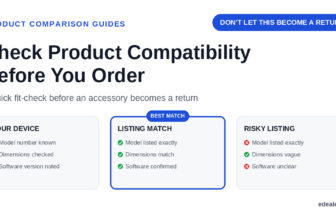
A listing claiming broad compatibility across many device models sometimes means a looser, less precise fit for all of them rather than a tight fit for any one. See our guide on checking product compatibility for how to verify a specific fit before buying.
It’s also worth applying the same scrutiny to where you’re buying the accessory from — a listing on an unfamiliar seller is more likely to carry a mismatched or uncertified item than one from a retailer you already trust. Our editorial independence policy covers how we vet accessory recommendations before including them in any comparison.
Original vs Compatible Accessories FAQ
Are compatible accessories always lower quality than original ones?
No — many established compatible-accessory brands match original quality and certification standards at a lower price. Quality varies far more by specific brand and listing than by the original-versus-compatible category alone.
Does using a compatible accessory void my device's warranty?
Usually not simply for using one — most manufacturer warranties only exclude coverage if the accessory is shown to have directly caused the damage. Check your specific manufacturer’s stated terms to be sure.
Which accessory categories carry the most real risk?
Chargers, batteries, and high-power charging cables carry the most risk, since a substandard version can affect device performance or, in rare cases, pose a safety issue.
What certification should I look for on a charger or battery?
Look for a recognized safety certification mark explicitly named in the listing — a vague claim of being “certified” with no named standard is a weaker signal.
Is it safe to buy a compatible case or screen protector?
Generally yes — purely physical accessories with no electrical component carry low risk even from a lower-cost compatible brand.
How can I check if a compatible accessory actually fits my exact device?
Confirm the accessory’s stated compatibility against your device’s exact model number, not just its general product family or marketing name.
Should I trust a compatible accessory with only a handful of reviews?
Treat it with more caution than one with hundreds of recent verified reviews, especially for electrical accessories where long-term reliability is the main concern.
Is a compatible accessory ever worth avoiding entirely?
Yes — for high-risk electrical categories, a listing with no stated safety certification and an unusually low price is generally not worth the saving relative to the risk.
Related Reading
- How to Compare Products Before You Buy With Confidence
- When Product Reviews Disagree, Which Ones Should Count?
- Product Model Numbers Explain What You Are Actually Buying
- How We Verify Listings and Claims
Check compatibility before you save
Search for the accessory and confirm the exact model it’s built for, or compare original and compatible pricing side by side.
Let the category, not the brand alone, set your caution level
A compatible accessory is a safe, sensible saving in most purely physical categories, and worth real scrutiny anywhere electricity is involved. Check for named safety certification, read long-term reviews, and confirm the exact device fit before letting the lower price decide for you.