 edeale
Watt-hours (Wh), not milliamp-hours (mAh), determine whether a power bank meets airline carry-on limits, since Wh accounts for both capacity and voltage. The conversion formula—mAh multiplied by voltage (typically 3.7V) divided by 1000—shows that a 20,000mAh bank equals roughly 74Wh, under the common 100Wh airline threshold.
The content warns against listings advertising implausibly high capacities, such as 100,000mAh at low prices, which would translate to physically implausible energy levels exceeding airline limits if genuine. It advises skepticism toward unusually high capacity claims paired with low prices, drawing a parallel to similar fake-specification patterns in other electronics categories, and points to additional verified deal roundups for related products.
Power Banks and Flights: The Number on the Box Isn't the Number That Matters
Airlines don't restrict power banks by mAh. They restrict by watt-hours, and most product listings only advertise the mAh figure.
This guide covers how to convert a power bank’s mAh rating to watt-hours, what UK and most international airlines actually allow in carry-on, and three real listings that make this easier by stating the watt-hour figure directly rather than leaving you to calculate it.
- Why airlines use watt-hours, not mAh, as the limit
- How to calculate Wh from a power bank's mAh rating
- The three airline tiers: under 100Wh, 100-160Wh, and over 160Wh
- Three real listings compared, including one that states Wh directly
- A red flag pattern worth checking for before buying
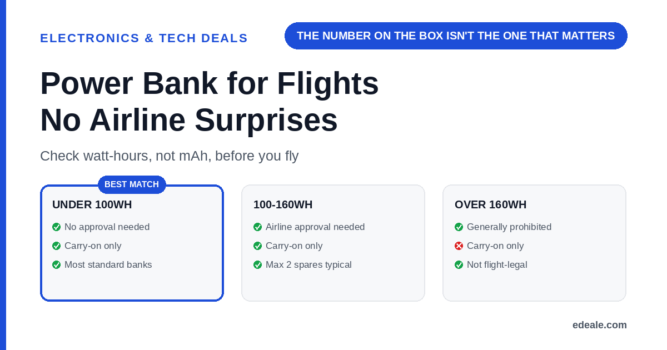
Most airlines, following IATA and UK CAA dangerous goods guidance, allow power banks up to 100Wh in carry-on without special approval. Between 100Wh and 160Wh typically requires airline approval in advance, usually limited to two spare batteries. Above 160Wh is generally prohibited on passenger flights entirely. Always check your specific airline’s policy before flying, since exact limits can vary slightly.
Why Watt-Hours, Not mAh
Milliamp-hours (mAh) measures charge capacity at a specific voltage, but it doesn’t directly indicate energy content unless you know the voltage. Watt-hours (Wh) is the actual energy measurement airlines use for safety limits, because it accounts for both capacity and voltage together. To convert: multiply the mAh rating by the battery’s voltage (typically 3.7V for standard lithium-ion cells), then divide by 1000. A 20,000mAh power bank at 3.7V works out to roughly 74Wh, comfortably under the common 100Wh threshold.
Airline Power Bank Rules: The Three Tiers
Airline Watt-Hour Tiers
Regardless of watt-hour rating, lithium-ion power banks are required to travel in carry-on baggage, not checked luggage, on virtually all airlines due to fire-risk regulations. This applies even to power banks well under the 100Wh threshold.
Three Real Listings, Compared for Flight Suitability
Portable Laptop Power Bank, Universal 98Wh/27000mAh, 100W AC 65W PD USB-C Charger
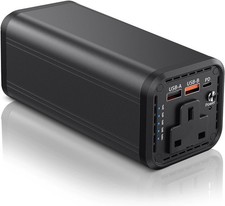
A power bank explicitly stating both 98Wh and 27000mAh in the listing, removing the need to calculate the watt-hour figure yourself before flying.
Baseus 100W Power Bank 20000mAh, Type C Fast Charging External Battery

A 20000mAh power bank from Baseus, an established charging accessory brand, working out to roughly 74Wh at standard lithium-ion voltage.
KONFULON 20000mAh 100W Power Bank, USB-C PD Fast Charger, TFT Display
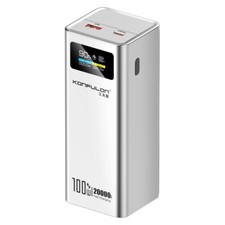
A 20000mAh power bank with a TFT display showing remaining charge, also working out to roughly 74Wh at standard voltage.
Pick 1 is the standout for flight preparation specifically, since it removes the calculation step and any doubt about the figure you’d report if an airline asked. Picks 2 and 3 still work fine for flying once you’ve done the mAh-to-Wh conversion yourself.
- All three picks calculate to comfortably under the common 100Wh airline threshold
- 20000-27000mAh capacity across all three covers multiple phone charges or a partial laptop charge during a long flight
- Pick 1’s direct Wh labelling removes guesswork specifically for air travel
- Picks 2 and 3 require you to do the mAh-to-Wh calculation yourself, since only mAh is stated directly
- Airline-specific rules can vary slightly from the common IATA guidance, so always confirm with your specific airline before flying
- None of these are checked-baggage options — power banks must travel in carry-on regardless of Wh rating
A Capacity Red Flag Worth Checking For
Some listings advertise implausibly high capacities, like 100,000mAh, at low prices. At standard voltage, that would work out to roughly 370Wh, which is both physically implausible for a portable device at that price and would be well over any airline’s carry-on limit if the figure were genuine. This mirrors a similar fake-capacity pattern seen in portable storage devices, and it’s worth treating an unusually high mAh claim at a low price with the same scepticism regardless of product category.
Power Banks for Flights: Frequently Asked Questions
What's the airline power bank limit in watt-hours?
Most airlines, following IATA guidance, allow up to 100Wh without special approval, 100-160Wh with advance approval, and prohibit anything over 160Wh. Always check your specific airline’s exact policy.
How do I convert mAh to Wh for my power bank?
Multiply the mAh rating by the voltage (typically 3.7V for standard lithium-ion) and divide by 1000. A 20,000mAh bank at 3.7V works out to roughly 74Wh.
Can I pack a power bank in checked luggage?
No, power banks must travel in carry-on baggage on virtually all airlines due to fire-risk regulations, regardless of their watt-hour rating.
Do all airlines use the same 100Wh threshold?
Most follow similar IATA-based guidance, but exact limits can vary slightly by airline — always check your specific airline’s stated policy before flying.
Is it better to buy a power bank that states Wh directly?
Yes, for flight preparation specifically, since it removes the need to calculate the figure yourself and gives you something concrete to reference if asked.
What should I do if my power bank is rated between 100Wh and 160Wh?
Contact your airline in advance for approval, and carry documentation of the rating, since this tier typically isn’t automatically permitted.
Is a 100,000mAh power bank realistic?
It’s a common red flag for fake-capacity listings — at standard voltage that would be roughly 370Wh, implausible for the price and size typically advertised, and well over any airline’s carry-on limit.
How many power banks can I bring on a flight?
Most airlines limit spare batteries in the 100-160Wh range to two per passenger; check your specific airline’s policy for banks under 100Wh, which is often more permissive.
Key Takeaways
- Airlines limit by watt-hours, not mAh. Convert mAh to Wh (mAh × voltage ÷ 1000) before assuming a power bank is flight-legal.
- 100Wh is the common no-approval threshold. 100-160Wh typically needs advance airline approval; over 160Wh is generally prohibited.
- Power banks are carry-on only. This applies regardless of watt-hour rating, on virtually all airlines.
- A listing stating Wh directly saves a calculation step. Useful specifically for frequent flyers who want documentation ready.
- Implausibly high mAh claims are a red flag. Treat them with the same scepticism as fake-capacity storage devices.
For more real, verified picks across categories, see edeale’s best wireless earbuds deals, best student laptop deals, and best streaming device deals.
edeale also tracks the Electronics & Tech Deals hub, the best VPN deals, and the best camera drones under $300 roundup, plus edeale’s live, verified deals feed.
edeale also compares budget vs premium products and checks product compatibility before an accessory purchase becomes a return.
For general power bank shopping beyond flight-specific rules, edeale’s broader best portable power bank deals roundup covers capacity and pricing across a wider range of options.
See Today's Verified Electronics Deals
Check edeale’s live, verified deals feed for current power bank and travel accessory pricing.
Conclusion
Check your power bank’s watt-hour rating, not just its mAh figure, before flying, and keep it in carry-on regardless of that rating. All three picks here fly comfortably under the common 100Wh threshold, with the first listing’s direct Wh labelling making that easiest to prove if you’re ever asked at security.