
 edeale
USB-C PD: Why the Charger You Grab Might Be Wrong for the Device
Not every USB-C cable and charger combination delivers the same power, even when the port looks identical.
USB-C Power Delivery (PD) is the standard that lets a single USB-C charger negotiate different power levels for different devices, from a phone needing 20W to a laptop needing 65W or more. Understanding wattage requirements prevents both underpowering a device (slow or no charging) and overpaying for capacity you’ll never use.
- What USB-C Power Delivery actually does
- Realistic wattage needs by device type
- Why the cable matters as much as the charger
- Can a higher-wattage charger damage a lower-power device?
- What to check before buying a USB-C charger or power bank
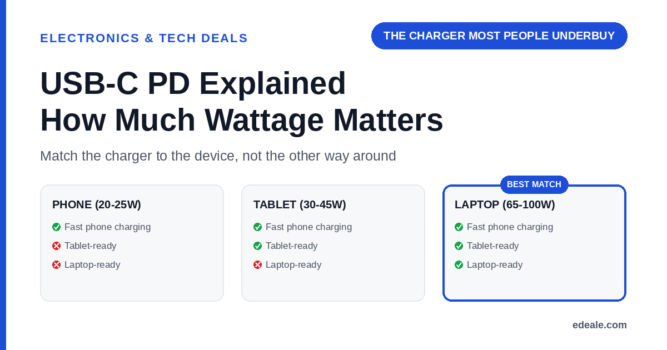
Most phones charge well at 20-25W. Tablets typically want 30-45W. Laptops range widely, commonly 45-100W depending on screen size and performance tier. USB-C PD devices negotiate the correct wattage automatically, so a higher-watt charger won’t damage a lower-power device, but the cable itself needs to be rated for the wattage you’re pushing through it.
What USB-C Power Delivery Actually Does
USB-C PD is a communication protocol, not a fixed power level. When you plug a PD-compatible device into a PD-compatible charger, they negotiate the appropriate voltage and current for that specific device, up to the charger's maximum rated output. This is why the same charger can correctly power a phone at a lower wattage and a laptop at a higher wattage without any manual switching, as long as both sides support PD.
Realistic Wattage Needs by Device
Wattage Needs by Device Type
PD negotiation means your phone will only draw the power it actually needs, even from a laptop-rated charger. It’s safe to use one higher-capacity charger across multiple devices, which is often more convenient and cost-effective than buying a separate charger for each one.
Why the Cable Matters as Much as the Charger
A high-wattage charger connected through a cable that isn't rated for that power level won't deliver the full charging speed, and in some cases won't charge reliably at all. USB-C cables have different power ratings, commonly capping at 60W or supporting up to 100W and above for cables specifically built for higher-wattage charging. If you've bought a higher-wattage charger but still see slow charging, the cable is a common overlooked cause.
USB-C PD Wattage: Frequently Asked Questions
What is USB-C Power Delivery?
A protocol that lets a compatible charger and device negotiate the correct voltage and current automatically, allowing one charger to correctly power multiple different device types.
Can a high-wattage charger damage my phone?
No. PD negotiation means the device only draws the power it actually needs, regardless of the charger’s maximum rated output.
Why is my laptop charging slowly with a USB-C charger?
Check that both the charger’s wattage rating and the cable’s power rating are sufficient for your laptop’s needs — a low-rated cable can bottleneck charging speed even with an adequate charger.
Do all USB-C cables support the same wattage?
No, cables have different power ratings. Some cap around 60W while others are built for 100W or higher — check the cable’s rating specifically if you’re charging a power-hungry device.
How much wattage does a typical laptop need?
It varies by model, typically 45-65W for thin, light laptops and 65-100W or more for larger or performance-focused models.
Can I use one charger for my phone, tablet, and laptop?
Yes, as long as it’s PD-compatible and rated for your highest-demand device’s wattage needs — it will correctly negotiate lower power for the phone and tablet.
What wattage should I look for in a power bank for laptop charging?
Match the power bank’s output wattage to your laptop’s charging needs, typically 45W or higher for most laptops.
Is a higher-wattage charger always better to buy?
Not necessarily — it’s more useful if you plan to charge higher-demand devices like a laptop. For phone-only charging, a lower-wattage charger is usually sufficient and cheaper.
Key Takeaways
- PD negotiates the correct wattage automatically. A higher-capacity charger won’t overpower or damage a lower-demand device.
- Match wattage to your highest-demand device. One good charger can often replace several device-specific ones.
- The cable's power rating matters too. A high-wattage charger paired with a low-rated cable won’t deliver full charging speed.
- Laptops need meaningfully more wattage than phones. Check your specific laptop’s requirements rather than assuming any USB-C charger will do.
- Power bank output wattage matters as much as capacity. Check output wattage specifically if you plan to charge a laptop from a power bank.
For more real, verified picks across categories, see edeale's best wireless earbuds deals, best student laptop deals, and best streaming device deals.
edeale also tracks the Electronics & Tech Deals hub, the best VPN deals, and the best camera drones under $300 roundup, plus edeale's live, verified deals feed.
edeale also compares budget vs premium products and checks product compatibility before an accessory purchase becomes a return.
See Today's Verified Electronics Deals
Check edeale’s live, verified deals feed for current charger and power bank pricing.
Conclusion
USB-C PD handles the power negotiation automatically, so the real decision is matching charger wattage to your highest-demand device and confirming your cable can actually carry that power. A single well-chosen charger can safely replace several device-specific ones.