 edeale
Photos Are the Least Reliable Way to Judge Size
Listing photos are staged to look proportional, and there's rarely a reliable object in frame to judge scale against. The dimensions in the specifications table are the only number worth trusting.
This guide covers how to actually measure your space, read a listing’s stated dimensions correctly, and catch the specific ways dimension listings mislead — before a too-big or too-small delivery becomes a return.
- Why listing photos consistently misrepresent real size
- What to measure in your own space before you compare anything
- The dimension details listings often leave out
- A short checklist to run before ordering anything size-sensitive
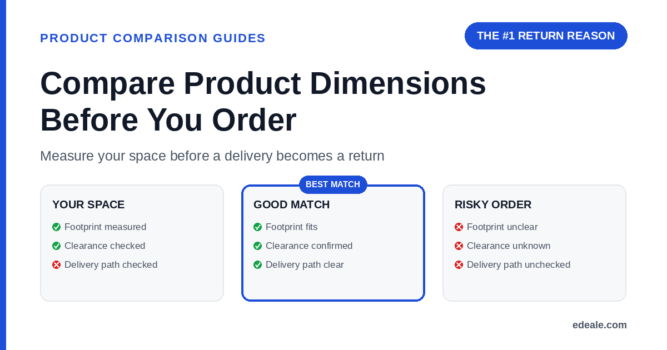
Measure the actual space first — including height clearance and any doorway or hallway the product needs to pass through to get there — so you’re comparing real numbers against real numbers instead of a photo against a guess.
Why Photos Alone Are Misleading
A product photographed against a plain background gives your eye nothing reliable to judge scale against. Even lifestyle photos showing a product “in context” often use forced perspective or a room styled to make the item look proportionally larger or smaller than it is. None of this is necessarily dishonest — it’s just how product photography works, which is exactly why the numbers in the specifications table matter more than the image.
What to Measure Before You Compare
What to Measure in Your Own Space
Reading a Listing's Stated Dimensions Correctly
Dimension Terms Worth Knowing
- Product dimensions
The size of the item itself — check whether this is the assembled or unassembled size, since listings don’t always specify.
- Packaging dimensions
The size of the shipping box, useful for confirming delivery-path clearance but not the same as the product’s own footprint.
- Footprint
The width-by-depth measurement of the base — the number that matters most for floor space planning.
- Clearance dimensions
Extra space needed for doors, lids, or drawers to open fully — often listed separately from the resting dimensions, if listed at all.
If a product has doors, drawers, or a lid, and the listing only states the closed footprint, you’re missing the number that actually determines whether it’ll work in a tight space. Message the seller directly if it isn’t stated.
A Checklist Before Ordering
How to Compare Dimensions Before You Order
-
Measure your available space with a tape measure
Width, depth, and height — write the actual numbers down rather than relying on memory or estimation.
-
Check the delivery path, not just the final spot
Confirm doorways, hallways, and any stairs the item needs to pass through will actually accommodate it.
-
Read the product dimensions, not just the packaging dimensions
Confirm which measurement the listing is showing you, since the two can differ meaningfully.
-
Check for clearance dimensions if the product opens or extends
Ask the seller directly if doors, drawers, or lids aren’t covered by the stated dimensions.
-
Compare against your written measurements, with margin
Leave a reasonable margin rather than ordering something that fits exactly to the millimeter, since minor variance is normal.
This takes ten minutes with a tape measure and prevents the single most common reason furniture and appliances get returned.
Where Comparisons Go Wrong
This is the same underlying discipline as comparing any two products properly — trust the stated numbers over the visual impression. It’s also worth confirming the exact model number, since different configurations of the same product family can have meaningfully different dimensions.
Search reviews for mentions of size, fit, or clearance specifically — buyers who were surprised by a product’s real dimensions usually say so. See our guide on reading reviews when they disagree for how to weigh what you find.
Where you buy from can affect this too — see our guide on choosing a trustworthy online retailer for how listing accuracy varies by seller. Our verification methodology covers how we confirm dimensions before featuring a product in any comparison on this site.
Comparing Product Dimensions FAQ
Why can't I just judge size from the product photos?
Product photography rarely includes a reliable object to judge scale against, and lifestyle photos can use styling or perspective that makes an item look larger or smaller than it actually is.
What's the difference between product dimensions and packaging dimensions?
Product dimensions describe the item itself, while packaging dimensions describe the shipping box — the two can differ meaningfully, so confirm which one a listing is showing you.
Do I need to measure the delivery path, not just the final spot?
Yes — a product that fits its intended space can still be undeliverable if it can’t pass through a doorway, hallway, or staircase along the way.
What are clearance dimensions and why do they matter?
Clearance dimensions cover the extra space needed for doors, drawers, or lids to open fully — without them, a product’s closed footprint can be misleading for tight spaces.
Should I order a product that fits my space exactly to the millimeter?
It’s safer to leave a reasonable margin, since minor manufacturing variance and measurement error are normal and can matter in an exact-fit situation.
How can I tell if listed dimensions are for the assembled or unassembled product?
Check the specifications table for a label clarifying this, and message the seller directly if it isn’t clear — the difference can be significant for furniture and larger items.
Do different configurations of the same product have different dimensions?
Often yes — confirm the exact model number and configuration, since size can vary meaningfully across otherwise similar-looking versions of a product.
Can reviews help confirm real-world sizing?
Yes — search reviews specifically for mentions of size, fit, or clearance, since buyers who were surprised by a product’s real dimensions typically mention it directly.
Related Reading
- How to Compare Products Before You Buy With Confidence
- Check Product Compatibility Before an Accessory Becomes a Return
- Product Model Numbers Explain What You Are Actually Buying
- When Product Reviews Disagree, Which Ones Should Count?
Measure twice, order once
Search for the exact product you’re considering to check its full specifications, or compare two options side by side.
Trust the tape measure, not the thumbnail
Dimensions are one of the few purchase details that are entirely knowable in advance, yet one of the most common reasons for a return. Measure your space, read the listing’s numbers carefully, and confirm clearance and delivery path before you order — it takes minutes and avoids a genuinely disruptive mistake.