 edeale
Price Tier Isn't a Proxy for Quality
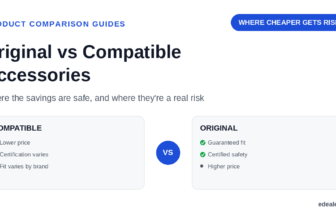
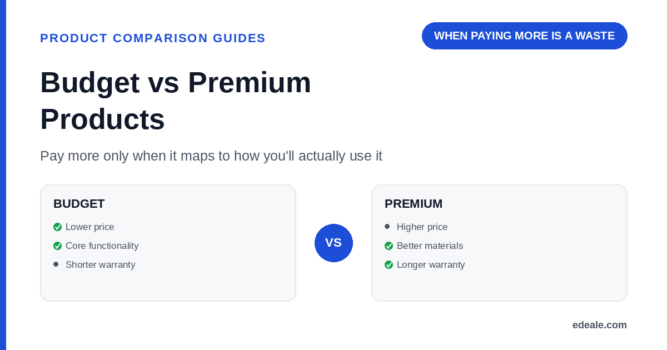
A premium price tag buys brand strength, materials, and sometimes genuinely better engineering — but not always in proportion to the extra cost. A budget price buys real savings, sometimes with a real trade-off attached, and sometimes with almost none.
This guide covers how to figure out which price tier actually matches your use case, the specific factors where premium pricing tends to be worth it, and the ones where it usually isn’t.
- The factors where paying more consistently pays off
- The factors where budget options usually perform just as well
- How to read a price tier's marketing without being swayed by it
- A short process for deciding your own budget-vs-premium call
Some of a premium price goes toward genuinely better materials or engineering, and some goes toward brand marketing and retail margin. The two aren’t the same thing, and only one of them shows up in how the product actually performs.
Budget vs Premium — Where the Difference Actually Shows Up
When Paying for Premium Tends to Pay Off
Situations Where Premium Is Usually Worth It
Where Budget Options Usually Hold Up Fine
- Core functionality is often genuinely comparable for everyday use
- Lower upfront cost frees up budget for accessories or a backup unit
- Simpler feature sets can mean less to go wrong and less to learn
- Materials or components can be a real weak point on heavy daily use
- Warranty and support windows are sometimes shorter
- Resale value is typically lower if you plan to sell it on later
Some of a premium product’s price reflects brand marketing spend and retail margin rather than measurable differences in materials or performance. Look for a specific, verifiable reason for the price gap before assuming it’s justified.
A Short Process for Deciding
How to Make the Budget-vs-Premium Call
-
Identify your actual use case
Daily heavy use and occasional light use justify very different answers to the same question.
-
List the specific premium features that map to that use case
Ignore extras you won’t use — score only the ones that address something real about how you’ll use the product.
-
Check the warranty and support gap in concrete terms
A vague “better support” claim is less useful than an actual number of years or a specific coverage difference.
-
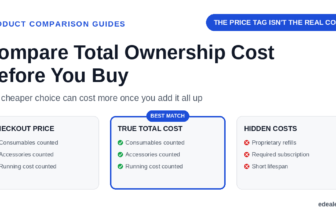
Compare total cost, not just sticker price
Factor in expected lifespan, accessories, and resale value, not just the number at checkout.
-
Read reviews for the specific failure points that matter to you
Reviews often reveal whether the budget option’s weak points are the ones you’d actually run into.
This process works the same whether you’re deciding on a £30 kitchen tool or a £900 piece of equipment.
Where Comparisons Go Wrong
This decision is really a specific case of comparing any two products properly — total cost of ownership, warranty terms, and your actual use case, rather than the price tag alone. Confirming the exact model number matters here too, since a “premium” listing can sometimes be an older or different configuration than it appears.
Spec sheets tell you what a product claims. Long-term ownership reviews tell you what actually breaks or disappoints — see our guide on reading reviews when they disagree for how to weigh them when comparing tiers.
edeale’s own comparisons follow the same rule laid out in our editorial independence policy: a higher price tier gets recommended only when the difference is real and relevant, never by default. Browse today’s verified deals to see current pricing across both tiers on products you’re considering.
Budget vs Premium FAQ
Is premium always worth the extra cost?
No — it depends on your actual use case. Premium pricing tends to pay off most for heavy daily use or components that are costly to replace, and less for occasional or light use.
How can I tell if a premium price reflects real engineering differences?
Look for specific, verifiable differences in materials, warranty terms, or performance — a vague “premium quality” claim without a specific backing detail is a weaker signal.
Are budget products always a false economy?
Not necessarily. Many budget products perform comparably for everyday use — the risk is concentrated in specific components or use cases, not the entire product uniformly.
Does a longer warranty always come with premium products?
Often, but not universally — check the actual stated warranty length for the specific product rather than assuming the price tier guarantees it.
How much does resale value matter in this decision?
It matters more if you plan to sell or upgrade within a few years — premium and well-known brands tend to hold value better, which offsets some of the higher upfront cost.
What's the biggest mistake people make comparing budget and premium?
Judging the decision by price tier alone instead of listing the specific features or durability factors that actually apply to their use case.
Should I always buy budget for a first purchase in a new category?
It’s a reasonable default when you don’t yet know your real usage pattern, as long as the budget option doesn’t have a known weak point in something you’ll clearly need.
Can total cost of ownership favor the premium option even at a higher upfront price?
Yes — if the premium option lasts meaningfully longer or needs fewer replacements or repairs, its total cost can end up lower despite the higher sticker price.
Related Reading
- How to Compare Products Before You Buy With Confidence
- Open-Box vs Refurbished: Which Risk Is Worth Taking?
- When Product Reviews Disagree, Which Ones Should Count?
- How to Choose a Trustworthy Online Retailer
Compare tiers before you decide
Line up a budget and premium option side by side, or search for the specific products you’re deciding between.
Pay for the difference you'll actually notice
Neither price tier is the automatically smarter choice. List the specific factors that matter for how you’ll actually use the product, check which tier genuinely delivers on them, and let that — not the price tag alone — make the call.