 edeale
Conflicting Reviews Aren't a Red Flag by Themselves
Almost every popular product has some one-star reviews sitting next to hundreds of five-star ones. The question isn't whether reviews disagree — they almost always do — it's which disagreements are actually meaningful.
This guide covers how to filter, weigh, and read reviews so a handful of vocal complaints don’t scare you off a genuinely good product, and a wall of glowing five-star reviews doesn’t talk you into a genuinely disappointing one.
- The signals that make one review more predictive than another
- A process for reading reviews when the ratings are split
- The rating patterns that actually indicate a real problem
- How to spot incentivized or fake reviews skewing the average
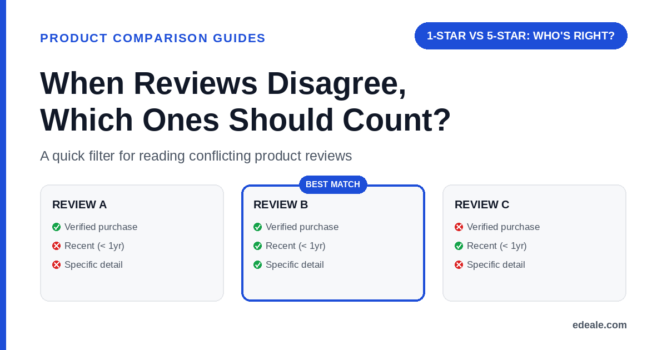
These two filters alone remove most of the noise: verified purchase confirms the reviewer actually bought the item, and sorting by recency surfaces reviews of the current version rather than an earlier one that may have since changed.
What Makes One Review Worth More Than Another
Not every review carries equal weight, and treating them as if they do is how a single dramatic complaint ends up outweighing hundreds of quietly satisfied buyers. A handful of signals reliably separate a useful review from a noisy one.
Signals a Review Is Worth Trusting
A Process for Reading Split Reviews
How to Read Reviews When the Ratings Disagree
-
Check the rating distribution, not just the average
A 4.2-star product with most reviews at 5 stars and a small spike at 1 star reads very differently from one evenly spread across 3 and 4 stars.
-
Read the negative reviews for a shared, specific complaint
One person describing a unique problem is an outlier. Twenty people describing the exact same failure is a pattern.
-
Check whether complaints cluster around a single batch or date
A cluster of complaints starting on a specific date can point to a manufacturing batch issue rather than a fundamental design flaw.
-
Weigh volume against your own use case
A complaint about a feature you’ll never use matters less than one describing exactly how you plan to use the product.
-
Cross-check with a second, independent source
Compare the pattern you’re seeing against an independent review site or forum thread — real problems tend to show up in more than one place.
This takes about five minutes once you’re used to it, and it consistently beats trusting the star average alone.
Where Comparisons Go Wrong
A sudden spike of near-identical five-star reviews, all posted within days of each other and all short on detail, is a common pattern in incentivized or fake review campaigns. Genuine reviews accumulate more gradually and vary more in wording and detail.
Understanding “verified purchase” also matters here: it confirms the reviewer bought the item through that platform, but it doesn’t confirm they used it for long, or that they weren’t given a discount in exchange for a review. It’s a useful filter, not a guarantee — pair it with the detail and recency checks above rather than relying on it alone. For more on how to weigh where you’re buying from in the first place, see our guide on choosing a trustworthy online retailer, since review quality and seller reliability tend to move together. Our own retailer guides go into more depth on specific sellers.
This process is also part of edeale’s own editorial process — we read the reviews behind a product, not just the average score, before recommending it in a comparison. It’s the same reason we’d rather flag a genuine, repeated complaint than smooth it over for the sake of a cleaner-looking recommendation.
Retailers sometimes merge reviews from multiple versions of a product onto a single listing page. Before trusting a pattern in the reviews, confirm you’re looking at feedback for the exact model number you’re comparing — see our guide on reading product model numbers for how to check.
Reading Product Reviews FAQ
Should I ignore a product with any one-star reviews?
No — almost every widely-sold product has some one-star reviews. What matters is whether the same specific complaint repeats across many reviews, not whether any exist at all.
How many reviews are enough to trust a product's rating?
A few hundred recent, verified reviews are far more reliable than a handful, since a small sample can be skewed by a single bad batch or a run of delivery problems unrelated to the product itself.
What does “verified purchase” actually confirm?
It confirms the reviewer bought the item through that platform — it doesn’t confirm how long they used it or whether they received any incentive to leave a review.
Are disclosed incentivized reviews trustworthy?
They can be — a disclosed incentive is a transparency signal, not proof of dishonesty. Undisclosed incentivized or fake reviews are the bigger risk, and they’re harder to filter for directly.
Why do reviews for the same product sometimes describe different problems?
Some retailers merge reviews from multiple product versions onto one listing page, so a review describing a specific problem may be about a different model number than the one you’re viewing.
What's the fastest way to spot fake or pile-on reviews?
Look for a sudden spike of short, similarly-worded five-star reviews posted within days of each other, especially right after a product launch — genuine reviews tend to accumulate more gradually with more variation in wording.
Should I trust reviews with photos more than reviews without?
For complaints about something visible — damage, wrong item, missing parts — yes, since a photo is harder to fabricate convincingly than a text description.
Is a 4.2-star rating better or worse than a 4.5-star rating with fewer reviews?
It depends on the review count and distribution — a 4.2-star rating from thousands of recent reviews is often more reliable than a 4.5-star rating from a few dozen.
Related Reading
- How to Compare Products Before You Buy With Confidence
- Product Model Numbers Explain What You Are Actually Buying
- How to Choose a Trustworthy Online Retailer
- How We Verify Listings and Claims
Put this review checklist to work
Use our comparison tool to weigh two products side by side, or search for the exact model you’re reading reviews about.
Disagreement in reviews is normal — patterns are what matter
Every popular product collects some negative reviews alongside the positive ones. The skill isn’t finding a product with zero complaints — it’s learning to tell a genuine, repeating pattern from an isolated, unrepresentative one, and weighing recent verified reviews more heavily than old or unverified ones.