
 edeale
TVs in Bright Rooms: The Specs That Actually Predict Glare
A TV that looks stunning in a dim showroom can turn into a mirror the moment daylight hits it at the wrong angle in your living room.
Glare performance comes down to a specific combination of screen coating, peak brightness, and panel type, not the overall picture quality reputation of a brand. This guide breaks down which specs actually predict how well a TV handles a bright, sunlit room, so you can check the right details before buying rather than guessing from marketing photos.
- Why panel type affects glare more than most people realise
- What an anti-glare or matte screen coating actually does
- How peak brightness affects visibility in daylight
- Where to physically place a TV in a bright room
- A checklist for bright-room TV shopping
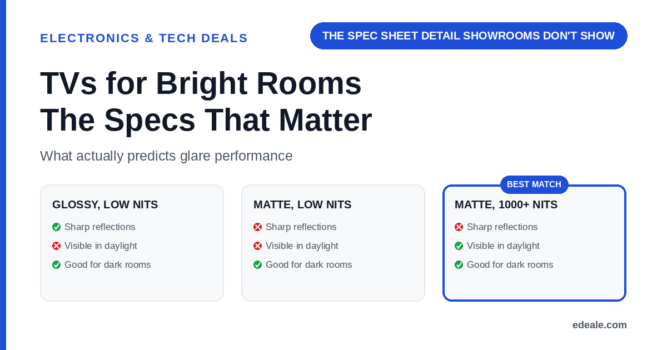
For a genuinely bright, sunlit room, prioritise a TV with a stated anti-reflective or matte screen coating and high peak brightness, typically 1000+ nits for HDR content to stay visible against ambient light. Panel type also matters: some panel technologies handle reflections better than others by design, so check that spec alongside brightness rather than assuming any premium TV automatically fixes glare.
Panel Type Affects Glare More Than Brand Reputation
Different TV panel technologies handle ambient light differently by their physical design, independent of how good the picture looks in a dark room. Some panels use a glossier surface that produces sharper, more visible reflections, while others incorporate anti-reflective layers as part of the panel itself, not just an added coating. This is a genuinely different spec from overall picture quality reputation, and it's worth checking the panel type specifically for a bright-room purchase rather than relying on a brand's general reputation.
What Anti-Glare Coating Actually Does
Key Specs for Bright-Room Viewing
A very bright screen can still produce a visible reflection if the coating is glossy and light hits it directly. Brightness and anti-glare coating solve related but different problems: brightness competes with ambient light overall, while coating specifically reduces the sharp mirror-like reflection of a direct light source.
Placement Matters as Much as the TV Itself
Even the best anti-glare TV performs worse if positioned directly opposite a window or bright light source. Positioning the screen perpendicular to the main light source, or using curtains or blinds during peak daylight hours, reduces glare regardless of which TV you buy. If repositioning isn't possible, prioritising screen coating and brightness specs becomes even more important, since the TV has to do more of the work on its own.
Bright-Room TV Shopping Checklist
-
Check the panel's stated coating
Look specifically for anti-reflective, anti-glare, or matte finish terminology in the spec sheet.
-
Check peak brightness in nits
1000+ nits is a reasonable threshold for genuinely bright rooms, especially for HDR content.
-
Consider your room's actual light direction
Note where windows and light sources sit relative to where the TV would be placed.
-
Plan for perpendicular placement if possible
Positioning the screen perpendicular to the main light source reduces glare regardless of TV spec.
-
Check return policy before committing
Glare performance is hard to judge from a showroom under different lighting than your actual room.
Confirm these before buying, since a showroom’s lighting rarely matches a genuinely sunlit living room.
TVs for Bright Rooms: Frequently Asked Questions
What screen coating handles bright rooms best?
A matte or anti-reflective coating, explicitly stated in the TV’s spec sheet, generally diffuses reflections better than a standard glossy finish.
How much peak brightness do I need for a bright room?
1000+ nits is a reasonable threshold for genuinely sunlit rooms, particularly for HDR content to remain visible against ambient light.
Does panel type matter more than brand for glare performance?
Yes, panel technology and coating are specific, checkable specs that matter more for glare than a brand’s general picture-quality reputation.
Can TV placement alone fix a glare problem?
It helps significantly — positioning the screen perpendicular to the main light source reduces glare regardless of the TV itself, but it won’t fully replace anti-glare coating in a very bright room.
Is a higher price always better for bright-room performance?
Not necessarily. Check the specific coating and brightness specs rather than assuming price alone predicts glare performance.
Do all premium TVs have anti-glare coating?
No, glossy finishes remain common even on premium models. Always check the specific spec sheet rather than assuming based on price tier.
Why does my TV look fine in the shop but reflective at home?
Showroom lighting rarely matches real-world conditions, especially direct sunlight. This is exactly why checking the coating and brightness specs matters more than in-store viewing alone.
What's the difference between anti-glare and anti-reflective coating?
The terms are often used interchangeably in marketing, but both aim to reduce visible reflections. Check the manufacturer’s specific technical description if precision matters to you.
Key Takeaways
- Check for stated anti-reflective or matte coating. Don’t assume any premium TV has this — glossy finishes remain common.
- 1000+ nits helps in genuinely bright rooms. Higher peak brightness competes better against ambient daylight.
- Panel type is a specific, checkable spec. It matters more for glare than overall brand reputation.
- Placement is a free, meaningful fix. Positioning the screen perpendicular to light sources reduces glare regardless of the TV.
- Showroom lighting doesn't predict home performance. Check the actual spec sheet rather than judging glare from an in-store viewing.
For more real, verified picks across categories, see edeale's best wireless earbuds deals, best student laptop deals, and best streaming device deals.
edeale also tracks the Electronics & Tech Deals hub, the best VPN deals, and the best camera drones under $300 roundup, plus edeale's live, verified deals feed.
edeale also compares budget vs premium products and checks product compatibility before an accessory purchase becomes a return.
See Today's Verified Electronics Deals
Check edeale’s live, verified deals feed for current TV and home entertainment pricing.
Conclusion
Glare performance in a bright room comes down to checkable specs, not brand reputation: look for a stated anti-reflective or matte coating and peak brightness of 1000+ nits, and pair that with sensible screen placement relative to your room’s light sources.