 edeale
Finding Real Clothing Deals
Most “70% off” clothing banners are measured against a price nobody ever paid.
Retailers can set almost any “original” price they like, then discount from there. That doesn’t mean every sale is fake — it means the sticker alone tells you nothing. This guide covers how to check a discount before trusting it, which UK retailers and sale calendars are worth watching, and the specific tricks that make a markup look like a markdown.
- Why the “original price” on a sale tag often isn’t real
- The five tactics that manufacture a fake discount
- Where genuine clothing sales actually show up in the UK
- A pre-purchase checklist you can run in under a minute
- When a coupon code is worth the extra step and when it isn’t
A clothing discount is worth trusting when you can verify the price against its recent history, not just the tag next to it. Check a price-history extension or the retailer’s own past-price disclosure, watch for a small number of predictable UK sale windows rather than chasing every banner, and treat stacked coupon codes on top of a big percentage-off claim as a signal to double-check, not a reason to buy faster.
This sits alongside edeale’s other Fashion & Apparel Deals coverage, which tracks specific retailers and product categories rather than the general hunting strategy covered here. A £70 jacket marked down to £35 looks identical whether it was genuinely £70 last month or was quietly relisted at £70 the week before the sale started. The percentage is real math on a number the retailer chose — checking whether that number is honest is the part that actually matters.
The Five Tactics That Manufacture a Fake Discount
Fake-Discount Myths vs. Reality
Many retailers raise the listed price shortly before a sale starts, so the “was” figure was only live for a few days, if at all.
Cross-check the price against a history tool before trusting the percentage.
Permanent countdown banners that reset on refresh, or reappear the next week under a new name, are common on fast-fashion sites.
Bookmark the item and check back in a few days — a real sale ending will actually end; a fake one won’t.
Scarcity counters on many platforms are generated by the page template, not tied to a live inventory feed, and can show the same count for weeks.
Treat stock counters as marketing copy unless the retailer shows a specific low-stock warning at checkout too.
A coupon on top of an already-inflated “sale” price can land you at, or above, the item’s normal price — the two discounts compound the same inflated base.
Check the final price in your basket against the price-history tool, not against the two percentages stacked together.
Countdown timers, low-stock badges and “last chance” banners are copy, not evidence. If a listing pressures you to decide in the next few minutes, that’s the moment to slow down and check the price, not speed up.
A Checklist Before You Buy
Pre-Purchase Checklist
-
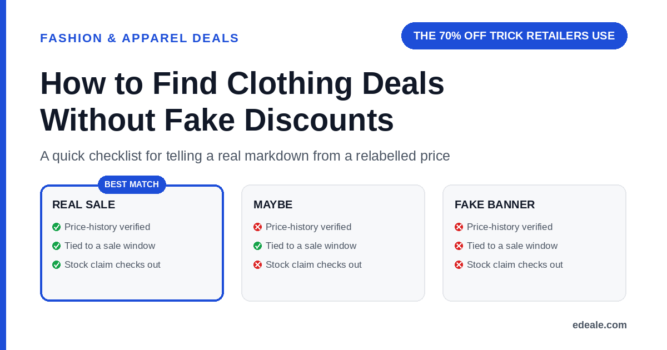
Check the price history
Use a browser price-history extension or the retailer’s own past-price disclosure (UK retailers must show the lowest 30-day price under Digital Markets, Competition and Consumers Act rules) before trusting a percentage.
-
Search the exact product name
Search the item’s name plus “review” or “sizing” on a second tab — this surfaces fit complaints and counterfeit warnings faster than the retailer’s own page will.
-
Compare the coupon against the sale price
Add the item to the basket and check whether the coupon code actually reduces the total, or whether it was already priced in.
-
Confirm the return window
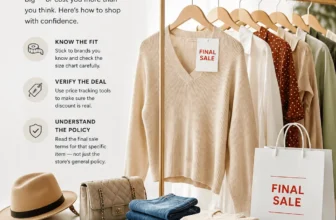
Final-sale and clearance tags often carry no-return policies — check before committing to anything you can’t send back.
-
Check the retailer, not just the item
A steep discount from a retailer with a poor return or delivery record isn’t a deal on its own.
Run through this before checkout, not after — most of it can’t be undone once an order ships.
Two of those steps deserve their own detail: edeale’s guide on buying final sale clothing without trying it on covers exactly when skipping the fitting room is a reasonable bet, and the guide to choosing online retailers covers what actually separates a trustworthy seller from a risky one.
UK clothing retailers cluster real markdowns around a handful of predictable windows: end-of-season clearance (roughly January and July), Black Friday week, and Boxing Day. Outside those windows, a “50% off everything” banner deserves more scrutiny, not less.
Where Real Clothing Deals Actually Show Up
Genuine clearance inventory tends to move through a small number of channels: end-of-season sale sections on a retailer’s own site, outlet-specific product lines (which are a different question from clearance — see edeale’s guide on spotting quality clothing before you pay more), and verified cashback or coupon aggregators rather than pop-up banner ads. Edeale’s Online Retailers hub tracks return policies and delivery reliability across the merchants that show up most often in these sales, and edeale’s Trending Deals page surfaces active, verified offers rather than every banner a retailer runs.
What Counts as a Real Discount
What Separates a Real Discount from a Relabelled Price
Clothing Deals: Frequently Asked Questions
What's the fastest way to check if a clothing discount is real?
Install a price-history browser extension or check the retailer’s own past-price disclosure, then compare it against the current sale price rather than the percentage badge.
Do coupon codes actually save money on top of a sale price?
Sometimes, but only if you check the basket total against the item’s price history — a coupon layered on an inflated sale price can land at or above the normal price.
Are outlet-only clothing lines the same quality as the regular in-season range?
Often not. Many outlet lines are manufactured separately, at a lower spec, specifically for outlet pricing, rather than being leftover stock from the main collection.
When do UK clothing retailers run their biggest real sales?
End-of-season clearance in January and July, plus Black Friday week and Boxing Day, are the windows most likely to carry genuine markdowns rather than a relabelled price.
Is it worth signing up for a retailer's email list just for the first-order discount?
Usually yes for a one-time purchase you were already planning, since the code is typically a real 10-15% off with no separate inflation to check for.
Should I trust a 'flash sale' countdown timer?
Treat it as marketing copy unless you’ve watched the same item at the same site across multiple days and seen the price genuinely change when the timer hits zero.
How do I find deals on clothing brands that rarely go on sale?
Check cashback portals and verified coupon aggregators rather than the brand’s own site, and watch for end-of-season clearance rather than promotional banners.
Is buying last season's stock actually cheaper in the long run?
Usually, for simple, non-trend-driven basics — it’s a weaker bet for anything trend-led, where last season’s cut or colour may already look dated.
Key Takeaways
- Check the base price first. A discount percentage is only as honest as the price it’s measured against — verify with a history tool before trusting the badge.
- Time your shopping to real sale windows. End-of-season clearance, Black Friday week and Boxing Day carry the most genuine markdowns.
- Stack coupons carefully. Check the basket total against price history, not the two percentages added together.
- Scarcity messaging isn't evidence. Low-stock counters and countdown timers are copy on most platforms, not a live inventory feed.
- Final-sale tags remove your safety net. Confirm the return policy before buying anything marked as clearance or final sale.
- Skip this approach if you need same-day certainty. Waiting for a verified sale window won’t help if you need an item this week — in that case, prioritise a reliable retailer over chasing the lowest possible price.
See Today's Verified Fashion Deals
Skip the guesswork and check edeale’s live, verified deals feed instead of chasing individual sale banners.
edeale tracks the verification methodology behind the deals it surfaces — the same checklist above is what sits behind that process.
Conclusion
A clothing discount is only as real as the price it’s measured against. Verify with a price-history check, shop the predictable UK sale windows instead of every banner, and treat urgency messaging as a reason to slow down rather than speed up.