 edeale
Acer Mini PC vs Small Form Factor PC: What Actually Differs
"Mini PC" and "small form factor PC" get used almost interchangeably in shopping searches, but they describe two different sizes of the same idea.
A mini PC like Acer’s Revo Box or Veriton line is one specific, extreme end of the small form factor category — sealed, fixed-configuration, and built around integrated graphics. “Small form factor” (SFF) is the broader umbrella, and it stretches all the way up to compact desktop towers that still fit a full-size graphics card. This guide compares real examples of each so the distinction is concrete, not just definitional.
- What actually makes a mini PC "mini"
- Where small form factor PCs are bigger and more capable
- Real Acer mini PC, Dell Micro, and SFF gaming PC examples compared
- Which one fits which use case
- What to check before choosing between the two
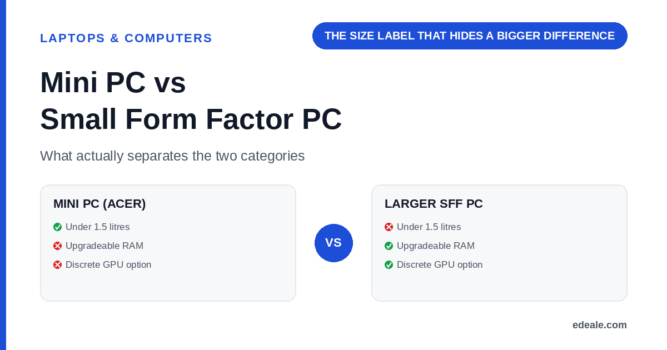
An Acer mini PC (Revo Box, Veriton N-series) is a sealed, ultra-compact desktop — typically under 1.5 litres — with soldered memory and integrated graphics only, no internal expansion. “Small form factor PC” is the wider category: it includes mini PCs like Acer’s, but also larger compact desktops (roughly 5-15 litres) such as Dell’s OptiPlex Micro or HP’s EliteDesk SFF line, some of which have room for a discrete graphics card and user-replaceable RAM or storage. If you need upgradability or real gaming graphics, look at the larger SFF category, not a true mini PC.
What Actually Makes a Mini PC "Mini"
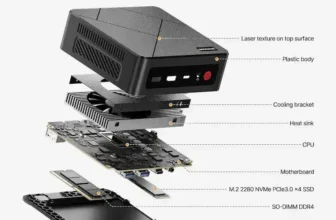
Acer’s mini PC line — the Revo Box AI and the older Veriton N-series — shares a specific set of traits that define “mini PC” as a category, not just a marketing label. The chassis is sealed and typically well under 1.5 litres, closer to the size of a paperback book than a desktop tower. Memory is soldered directly to the board on current models, meaning there’s no RAM upgrade path after purchase, and graphics are integrated into the processor rather than a separate card. That combination is what actually defines a mini PC — the tiny size is a consequence of those component choices, not the other way around.
Where Small Form Factor PCs Are Bigger and More Capable
“Small form factor” covers a much wider range than mini PCs alone. At the compact end, something like a Dell OptiPlex Micro sits close to mini PC territory in size, but many Micro-line and SFF-badged desktops from Dell and HP use standard SODIMM memory that a user can actually upgrade, and some support a low-profile discrete graphics card. Go up further in the SFF range — a mini-ITX gaming build in a case like a Jonsbo or Fractal Design enclosure — and you’re looking at roughly 5-15 litres, with room for a full discrete GPU, a dedicated power supply, and the kind of internal upgrade path a true mini PC was never designed to offer.
Real Examples Compared
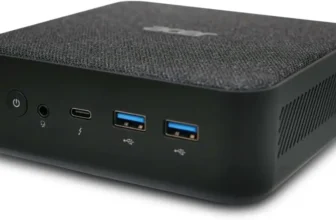
Example 1: Acer Veriton N4670GT — True Mini PC
Example 2: Dell OptiPlex Micro — Compact SFF
Example 3: Mini-ITX SFF Gaming PC — Larger SFF
Size and capability move together here: the true mini PC is the smallest and least flexible, the OptiPlex Micro trades a little size for real RAM and storage upgradability, and the mini-ITX gaming build gives up compactness entirely in exchange for a discrete GPU and a full upgrade path. There’s no single “best” size — it depends entirely on whether you value desk space or future flexibility more.
- True mini PCs (Acer Revo Box, Veriton) are the smallest, quietest, and most power-efficient option for basic desktop use
- Larger SFF PCs (Dell OptiPlex Micro and similar) add real memory and storage upgradability without a huge size increase
- The largest SFF category (mini-ITX gaming builds) can match a full tower’s graphics performance in a fraction of the footprint
- A true mini PC can’t be upgraded later — what you buy is what you’re stuck with
- Discrete-GPU SFF builds cost meaningfully more and run hotter and louder than a sealed mini PC
- Mid-size SFF desktops like the OptiPlex Micro still can’t fit a full-length discrete graphics card
Which One Actually Fits Your Use Case
Matching the Category to Your Actual Use
-
Basic browsing, streaming, office work
A true mini PC like Acer’s Revo Box or Veriton line covers this comfortably and takes up almost no desk space.
-
Light multitasking with room to grow
A compact SFF desktop with upgradeable RAM, like a Dell OptiPlex Micro, gives you headroom a sealed mini PC can’t.
-
Gaming or GPU-dependent creative work
Only a larger SFF build with a discrete graphics card handles this — no true mini PC has the internal space for a dedicated GPU.
-
Desk space is the top priority
Accept the fixed-configuration trade-off and go with the smallest true mini PC that meets your specs today, not what you might need in two years.
Decide based on whether you’ll need to upgrade later, not just today’s specs.
Acer Mini PC vs Small Form Factor PC: Frequently Asked Questions
What is the actual difference between a mini PC and a small form factor PC?
A mini PC is a specific, extreme end of the small form factor category — sealed, fixed-configuration, and under about 1.5 litres. “Small form factor” is the broader umbrella that also includes larger compact desktops, some of which support upgradeable memory and even a discrete graphics card.
Are all Acer mini PCs the same size as a small form factor PC?
No. Acer’s mini PCs (Revo Box, Veriton N-series) sit at the smallest, most sealed end of the SFF spectrum. Other SFF desktops, like Dell’s OptiPlex Micro or an HP EliteDesk SFF, are meaningfully larger and offer more internal flexibility.
Can you upgrade the RAM in an Acer mini PC?
No — current Acer Revo Box and most Veriton mini PC models use memory soldered directly to the board, with no upgrade path after purchase. This is one of the defining traits that separates a true mini PC from a larger SFF desktop.
Can a small form factor PC have a graphics card?
Yes, at the larger end of the category. A mini-ITX SFF gaming build can house a discrete GPU like an RTX 3050, something no true mini PC has the internal space for.
Is a small form factor PC always bigger than a mini PC?
Generally yes, though the gap varies — a compact SFF desktop like a Dell OptiPlex Micro is only slightly larger than a mini PC, while a mini-ITX gaming SFF build is substantially bigger to fit a discrete GPU and power supply.
Which is better for a home office: a mini PC or a small form factor PC?
For basic home office use, a true mini PC is usually the better fit — it’s smaller, quieter, and cheaper, and most office tasks don’t need upgradeable RAM or a discrete GPU.
Do small form factor PCs cost more than mini PCs?
It depends entirely on the configuration. A basic compact SFF desktop can cost similarly to a mini PC, but a discrete-GPU SFF gaming build costs substantially more, reflecting the added graphics hardware.
Why would someone choose a larger SFF PC instead of the smallest mini PC available?
Mainly for upgradability or graphics performance — a larger SFF desktop can be opened up later for more RAM, storage, or even a GPU, while a sealed mini PC is fixed at whatever configuration you originally bought.
Key Takeaways
- A mini PC is the smallest, most sealed end of the SFF category. Fixed memory, integrated graphics only, typically under 1.5 litres.
- "Small form factor" is the broader umbrella term. It includes mini PCs but also larger, more flexible compact desktops.
- Upgradability is the real dividing line, not just size. Some SFF desktops take standard RAM and storage; true mini PCs never do.
- Only larger SFF builds fit a discrete graphics card. No true mini PC, including Acer’s Revo Box or Veriton line, has room for one.
- Match the category to whether you'll need to upgrade later. Not just to today’s specs or the smallest footprint available.
For more on choosing between compact desktop categories, see edeale’s Mac Mini M4 price comparison and the Best Student Laptop Deals roundup if a laptop might suit your space better than any desktop form factor.
edeale also tracks the Laptops & Computers hub, the Electronics & Tech Deals hub, and edeale’s live, verified deals feed for current mini PC and SFF PC pricing.
See the Best Acer Mini PC Picks
Check edeale’s dedicated Acer mini PC roundup for real UK-relevant configuration comparisons.
Conclusion
A mini PC is one specific, sealed, fixed-configuration end of the small form factor spectrum — Acer’s Revo Box and Veriton lines are true mini PCs in that sense. “Small form factor” itself is the broader category, stretching up to compact desktops that take standard upgradeable memory and even a discrete graphics card. Choose based on whether you’ll ever need to upgrade or add real graphics power, not just on which one looks smallest in a product photo.