 edeale

Best Rice Cookers of 2026: Multicooker vs. Dedicated
A dedicated rice cooker and a multicooker can both make good rice, but they solve different problems. Buy the wrong one and you either overpay for functions you'll never touch, or fight a one-trick machine that can't do what you actually need.
This guide compares three real, widely sold machines: the Cosori 10-Cup multicooker, the Instant Pot Duo 7-in-1, and the Aroma ARC-914SBD dedicated rice cooker. Every spec below comes from the manufacturer’s own listing, not marketing copy, and we say plainly where we could not verify a live price.
- Whether a multicooker is worth the extra money over a dedicated rice cooker
- Real capacity, function, and keep-warm differences between all three models
- A side-by-side comparison table you can scan in under a minute
- Answers to the most common rice cooker sizing and safety questions
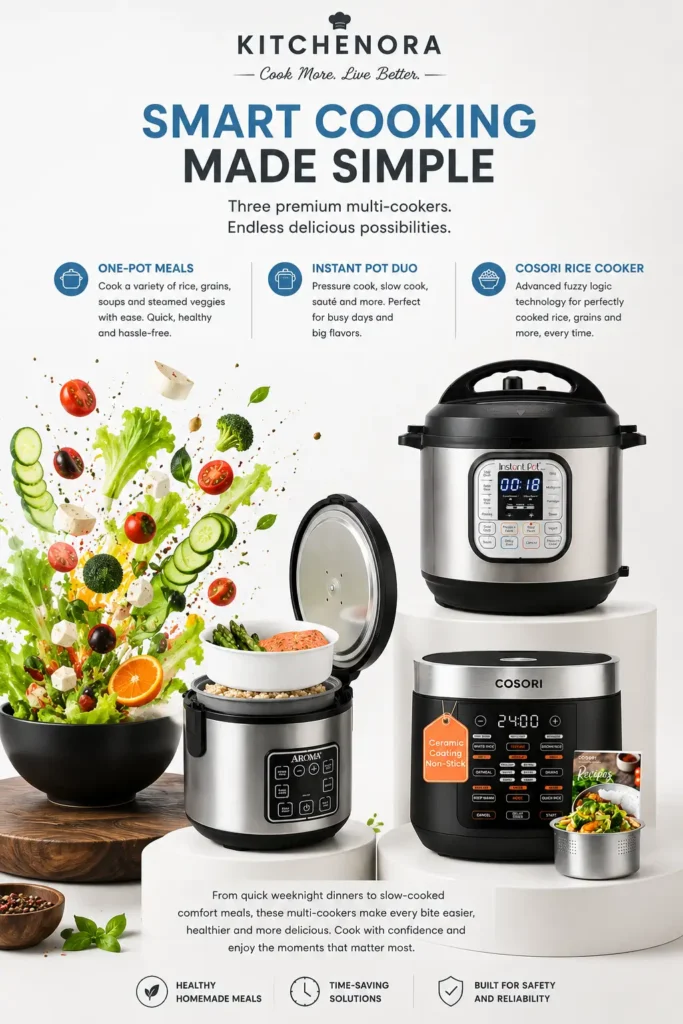
If you only ever cook plain rice and want the smallest, cheapest, simplest machine, get a dedicated cooker like the Aroma ARC-914SBD. If you want one appliance that replaces a slow cooker, steamer, and sauté pan too, a multicooker like the Cosori or Instant Pot earns the extra counter space.
None of these three machines is objectively “the best” rice cooker. They’re built for different kitchens. A single person who wants dinner rice on a timer needs almost none of what a 6-quart pressure multicooker offers, and a family that meal-preps in bulk will find a 4-cup dedicated cooker limiting within a month.
A dedicated rice cooker has one job and one control. A multicooker (Cosori, Instant Pot) adds pressure cooking, slow cooking, steaming, or yogurt-making in the same footprint, at the cost of a busier control panel and, usually, a higher price.
Pre-Purchase Checklist
-
Count your real batch size
Size for your largest common cooking occasion (guests, meal prep), not your average weeknight portion.
-
List the functions you will actually use
Slow cook, steam, sauté, and yogurt only pay off if you would otherwise buy those appliances separately.
-
Check the inner pot material
Ceramic non-stick is easier to clean but more prone to chipping than stainless steel.
-
Confirm keep-warm duration
If you eat at unpredictable times, a longer keep-warm window matters more than extra functions.
-
Check for delay-timer support
Only the Cosori in this comparison lets you schedule a start time in advance.
Cosori Rice Cooker 10 Cup
Cosori 10 Cup — Specifications
- 18 cooking functions cover rice, slow cooking, steaming, sautéing, and yogurt in one machine
- Ceramic non-stick pot avoids the older PTFE coatings found in cheaper rice cookers
- Includes a stainless steel steamer basket, so steaming vegetables needs no separate purchase
- 24-hour keep warm and a delay-start timer both included
- 18 functions means a busier control panel than a single-purpose cooker
- Ceramic coatings chip more easily than stainless steel if used with metal utensils
- Larger footprint than a basic 4-cup rice cooker
The 18-in-1 label sounds like marketing inflation until you actually use it: congee, cake, and yogurt settings are real, tested cooking modes, not the same rice program relabeled six times. The ceramic pot is the trade-off worth knowing about upfront — it cooks and cleans easier than stainless, but it won’t tolerate a metal whisk the way the Instant Pot’s steel pot will.
For a household replacing three single-purpose appliances with one, the Cosori is the practical pick in this comparison. If your kitchen already has a slow cooker and a steamer, though, you’re paying for functions you already own — see the dedicated-cooker option below instead.
The best all-rounder in this comparison if you will actually use its slow-cook, steam, and yogurt functions instead of leaving them untouched.
1 cup of uncooked rice yields roughly 2-3 cups cooked. A “10 cup” machine like the Cosori is rated by uncooked capacity, so it can produce far more finished rice than the number on the box suggests — size up only if you regularly cook for guests.
Instant Pot Duo 7-in-1
Instant Pot Duo — Specifications
- Combines pressure cooking, slow cooking, rice cooking, steaming, sautéing, and yogurt-making in one pot
- Stainless steel inner pot is dishwasher-safe and resists scratching from metal utensils
- Companion app with 800+ recipes is genuinely useful for people new to pressure cooking
- Wide market share means parts and accessories are easy to find
- Pressure cooking is the primary design intent; rice cooking is a secondary function, not the reason to buy it
- 6-quart capacity is sized for pressure-cooked batches, larger than most households need for rice alone
- Sealing ring can retain odors from strongly flavored meals unless cleaned promptly
The Duo’s rice setting works, but it’s tuned as one of seven functions rather than the machine’s whole purpose. If pressure cooking beans, stews, or stock is already on your list, the rice function is free value on top. If pressure cooking isn’t something you’ll use, the 6-quart footprint is oversized for the job.
Compare this against the smaller dedicated cooker below: the Aroma trades away every one of the Duo’s seven functions except rice and steaming, in exchange for a footprint and price built for exactly that job.
Worth it if pressure cooking is genuinely on your list. As a rice-cooker-only purchase, it is oversized and more expensive than it needs to be.
Aroma ARC-914SBD
Aroma ARC-914SBD — Specifications
- Single-purpose design keeps the control layout to a start switch and a keep-warm light
- 4-cup uncooked / 8-cup cooked capacity fits most 1-3 person households without wasted space
- Stainless steel exterior with cool-touch handles
- Included steam tray lets you steam vegetables above the rice as it cooks
- No delay timer or programmable functions beyond cook and warm
- Standard non-stick coating, not the ceramic coating found on pricier multicookers
- Capacity is too small for households that regularly cook for five or more people
There’s nothing to configure on the Aroma beyond turning it on. That’s a deliberate trade: no delay timer, no multi-function menu, no learning curve. For anyone who has never wanted a slow cooker or a yogurt maker, that simplicity is the actual selling point, not a missing feature.
The 4-cup uncooked capacity is the real limit here. It comfortably feeds one to three people but runs out of headroom fast if you regularly cook for a larger household or batch-cook for the week — in that case, the Cosori’s larger capacity is worth the extra cost even if you never touch its other 17 functions.
The best choice for anyone who only wants rice, done simply, in the smallest and cheapest machine of the three.
Rice cookers and multicookers are frequently listed with a struck-through “was” price that was rarely the real selling price. Check a price-history tool or compare the same model across two retailers before treating a discount banner as real savings.
What to Look For When Buying a Rice Cooker or Multicooker
Buying Criteria
How We Compared These Three Machines
How We Compared These Three Machines
Every spec in this guide (capacity, function count, inner pot material, keep-warm duration, timer availability) was cross-checked directly against each manufacturer’s own product listing rather than taken from a press release or a competitor’s roundup.
- Spec verification
- Pricing
- Ratings
We would rather tell you a price import failed than publish a guessed number.
Is a Multicooker Worth the Extra Money?
We can’t give you a live price comparison in this article (see Methodology above), so this is a function-for-money question, not a dollar-for-dollar one. A multicooker earns its higher price only if you would otherwise buy two or three separate appliances — a rice cooker, a slow cooker, and a steamer. If you’d only ever use the rice function, that price difference is pure premium for capability you won’t touch.
Check the current price directly on the retailer page for each model before deciding; list prices on all three of these products change often enough that any number we printed here would likely be stale within weeks.
FAQ
What's the difference between a rice cooker and a multicooker?
A dedicated rice cooker has one job: cooking rice with a simple cook/warm switch. A multicooker adds functions like pressure cooking, slow cooking, steaming, or yogurt-making in the same appliance, usually at a higher price and with a more complex control panel.
How much rice does a "10 cup" rice cooker actually make?
Rice cooker capacity is almost always listed as uncooked rice volume. A 10-cup uncooked machine like the Cosori yields roughly 20 cups of cooked rice, since rice roughly doubles in volume when cooked.
Do multicookers make worse rice than dedicated rice cookers?
No. Multicookers like the Cosori and Instant Pot use the same fuzzy-logic or pressure-based rice programs as dedicated cookers; the rice quality difference comes down to the specific model’s program tuning, not whether it has other functions.
Is the Instant Pot Duo good for rice specifically?
Yes, its rice setting works well, but rice is one of seven functions rather than the machine’s core purpose, so buying it purely for rice cooking means paying for pressure-cooking capability you may not use.
How long can you leave rice on "keep warm" safely?
Most rice cookers, including the Cosori (up to 24 hours) and the Instant Pot and Aroma (standard warm cycles), are designed to hold rice at a safe serving temperature, but rice quality and texture degrade the longer it sits, so most manufacturers and food-safety guidance recommend eating within a few hours for best results.
Are ceramic non-stick inner pots better than stainless steel?
Ceramic non-stick pots, like the one in the Cosori, are easier to clean and don’t require oil, but they can chip if scraped with metal utensils. Stainless steel pots, like the Instant Pot’s, resist scratching better but rice is more prone to sticking without added fat.
Do I need a rice cooker with a delay timer?
Only if you want rice ready at a specific time without being home to start it. Of the three machines compared here, only the Cosori includes a true delay-start timer.
Can I cook rice at high altitude in these machines?
All three machines can cook rice at high altitude, but cooking times may need adjustment since water boils at a lower temperature; check each manufacturer’s manual for altitude-specific guidance rather than assuming standard settings will work identically.
Is a smaller dedicated rice cooker enough for a family of four?
The Aroma ARC-914SBD’s 4-cup uncooked capacity (about 8 cups cooked) can feed a family of four for one meal, but it leaves little room for leftovers or larger gatherings, so a bigger machine like the Cosori is worth considering if you regularly cook in bulk.
Comparing another kitchen appliance?
See more real, verified kitchen and home appliance comparisons in the Home and Garden Deals hub.
Conclusion
Buy the Aroma ARC-914SBD if rice is the only job you need done — it’s the smallest, cheapest, simplest of the three. Buy the Cosori 10-Cup if you’ll genuinely use its extra functions in place of other appliances. Buy the Instant Pot Duo if pressure cooking is the real reason you’re shopping, with rice cooking along for the ride.