
 edeale
Best Dash Cams of 2026
A dash cam is only as good as the footage it hands you after something goes wrong, not the marketing copy on the box.
We compared four current dash cams on sensor quality, channel count, and real retail pricing instead of manufacturer claims. Every price below is what retailers were charging at the time of writing. Check it against a price-history tool before you buy, since dash cam listings get discounted and re-inflated on a near-weekly basis.
- Best overall: Viofo A229 Pro (4K front + 2K rear, $329.99)
- Best for interior monitoring: Vantrue N4 Pro (3-channel, ~$319.99-$379.99)
- Best budget dual-channel: 70mai 4K A810 ($179)
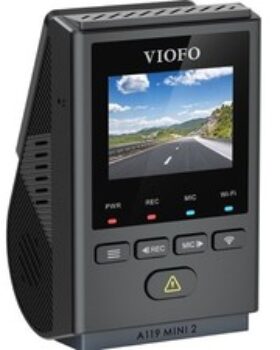
- Best compact single-channel: Viofo A119 Mini 2 (regularly $139.99, often on sale)
The Viofo A229 Pro is the strongest all-around pick right now: 4K front footage on a Sony STARVIS 2 sensor, a 2K rear camera, and GPS with 5GHz WiFi, all for a price that undercuts most 4K rivals. If you need a camera watching the cabin too (rideshare driving, teen driver monitoring), the Vantrue N4 Pro’s 3-channel setup is the better fit despite costing more.
Dash cam pricing swings hard around sales events, and “was $X” banners on these listings are not always honest anchors. Cross-check any price against Amazon’s own order history or a tracker like CamelCamelCamel before treating a discount as real.
What actually matters in a dash cam
Viofo A229 Pro

Specifications
- Sony STARVIS 2 sensor on both front and rear cameras, not just the front
- 5GHz WiFi transfers footage noticeably faster than the 2.4GHz-only cameras in this roundup
- 24-hour parking mode is a real spec, not marketing shorthand
- No interior-facing camera option on the 2-channel version — step up to 3-channel for cabin footage
- $329.99 is a real jump over the budget picks in this guide
What actually separates the A229 Pro from cheaper ‘4K’ dash cams is the sensor generation, not the resolution number on the box. STARVIS 2 sensors gather meaningfully more light, which shows up as usable license-plate detail in footage shot after dark, not just in daytime demo clips.
If you’ve compared dash cam listings and noticed prices swinging by $50-$80 within a week, that’s normal for this category, not a sign of a scam. Check the price against the retailer’s own history before deciding whether a current listing is actually a deal.
Vantrue N4 Pro
Specifications
- Only camera in this guide that records the cabin in real 1080p with dedicated IR night vision
- Same STARVIS 2 front sensor as the pricier A229 Pro
- 512GB storage support means fewer overwrite gaps on long trips
- Rear and interior cameras cap at 1080p, not 4K — fine for identification, not for reading distant plates
- Priced $10-$50 above the A229 Pro depending on the retailer, for a feature (interior camera) many drivers won’t use
Rideshare and delivery drivers are the clearest use case here — a passenger dispute with only outward-facing footage is a lot harder to resolve than one with a synced interior angle. For a typical daily commuter, the third camera is dead weight.
The price range we found ($319.99 to $379.99) reflects real retailer variation, not a placeholder. Compare at least two listings before buying — a $60 spread on the same camera is common in this category.
70mai 4K A810

Specifications
- $179 for a genuine 4K front + rear pair undercuts the other 4K options here by $150+
- 70mai’s app and firmware update history is more consistent than most budget dash cam brands
- 70mai has not published a STARVIS 2 sensor spec for this model, so night footage likely trails the Viofo and Vantrue picks
- GPS and 5GHz WiFi are not confirmed included at this price point — check the current listing before assuming parity with the pricier picks
Resolution and sensor quality are not the same thing, and the A810 is the clearest example in this guide. It hits the same 3840×2160 number as the two pricier cameras, but without a confirmed STARVIS 2 sensor, don’t expect identical low-light results.
For daytime commuting and parking-lot coverage, that gap matters less. For anyone who drives mostly at night or wants the sharpest possible plate capture in dark conditions, the extra cost of the A229 Pro is buying a real, measurable improvement, not just a brand name.
Viofo A119 Mini 2

Specifications
- Same-generation STARVIS 2 sensor as the $329.99 A229 Pro, in a single-channel camera under $140
- Small enough to mount without it being obviously visible from outside the car
- 60fps at 2K is genuinely useful for reading fast-moving plates in accident footage
- No rear or interior camera option — this is a front-only camera by design
- 2K tops out below the 4K front resolution of the A229 Pro and A810
This is the camera we’d point a budget-conscious buyer toward first. It shares its sensor generation with the $329.99 flagship pick, which means the biggest real-world quality gap (night footage) is largely closed, for less than half the price.
The regular price of $139.99 is worth knowing before you buy, because this model is discounted often enough that $100-$120 should be treated as the realistic target price, not a rare doorbuster.
Before you buy any dash cam
-
Confirm the sensor generation
Search the exact model name plus “STARVIS 2” or the sensor part number — don’t rely on the word “4K” alone.
-
Check a price-history tool
CamelCamelCamel (Amazon) or the retailer’s own price history before trusting a “was $X” banner.
-
Decide if you need interior footage
Only pay for a 3-channel camera if you actually have a use case for cabin recording.
-
Budget for a memory card and hardwire kit separately
Most dash cams don’t ship with a card large enough for 512GB support, and parking mode usually needs a hardwire kit sold separately.
Dash cam listings are a common home for anchor-price inflation — the “regular” price gets raised right before a “sale” banner goes up. Check the actual price history, not the crossed-out number on the listing, before treating any discount as real.
A 512GB-capable dash cam usually ships with no card or a small one. Buying a high-endurance microSD card separately (rated for continuous dash cam recording, not a standard consumer card) is almost always cheaper than the bundle price.
Two cameras can both say “4K” and produce very different footage after dark. The sensor generation (STARVIS 2 vs. an unnamed/older sensor) is the bigger factor once the sun goes down — check for it specifically.
Dash cam FAQ
Do I need a 3-channel dash cam?
Only if you need footage of the car’s interior — rideshare and delivery drivers benefit most; a typical commuter is usually well served by a 2-channel front/rear setup.
What does STARVIS 2 actually mean for footage quality?
STARVIS 2 is Sony’s current-generation image sensor line, and it gathers meaningfully more light than older sensors at the same resolution, which shows up as sharper, more usable footage after dark.
Do dash cams need a separate memory card?
Most dash cams ship with no card or a small one, so budget for a separately purchased high-endurance microSD card rated for continuous loop recording.
Does parking mode work without a hardwire kit?
No — parking mode that records while the car is off almost always requires a hardwire kit sold separately from the camera itself.
Are dash cam sale prices usually real?
Not always — check a price-history tool like CamelCamelCamel before trusting a “was $X” banner, since anchor-price inflation is common in this category.
Is 4K resolution worth paying more for?
It’s worth it mainly for reading license plates and street signs at a distance; for basic accident documentation, a well-reviewed 2K camera with a good sensor is often enough.
Can I install a dash cam myself?
Yes — the camera itself typically mounts with an adhesive suction mount in minutes; only the hardwire kit for parking mode involves running a cable behind trim panels.
Do these dash cams work with rideshare apps like Uber or Lyft?
Yes, but check your specific platform’s dash cam policy first — some rideshare companies restrict audio recording of passengers by state law.
Best overall pick — Sony STARVIS 2 sensors front and rear, GPS, 5GHz WiFi, and a real 24-hour parking mode for $329.99.
Best pick if you need synced interior footage — 3-channel front/cabin/rear recording for rideshare, delivery, or teen-driver monitoring.
Best budget pick — genuine 4K front and rear recording for $179, without the confirmed night-sensor advantage of the pricier picks.
Best value pick — the same sensor generation as the $329.99 flagship, in a single front-facing camera usually available for $100-$120.
If you’re buying through a third-party marketplace seller rather than directly from a manufacturer, it’s worth reading how to avoid fake eBay sellers and whether Walmart marketplace sellers are reliable before checking out, and knowing how to return an Amazon third-party item if the unit that arrives doesn’t match the listing.
See more automotive deals and price comparisons
Browse current automotive deals and cashback offers before you check out.
Bottom line
The Viofo A229 Pro is the dash cam we’d buy first at $329.99 — a genuine STARVIS 2 sensor front and rear, GPS, and fast WiFi transfer. Budget-conscious buyers get nearly the same night-footage quality from the $100-$120 Viofo A119 Mini 2, and anyone who needs cabin footage should look at the Vantrue N4 Pro instead.
For another practical home-tech category, see our real-price roundup of smart home devices.
Another practical electronics category worth the same scrutiny — see our roundup of portable power bank deals.